

Interludes and chapters
When it is created, a sub-graph is given a Mode, which decides the way it fits into the story. There are three modes.
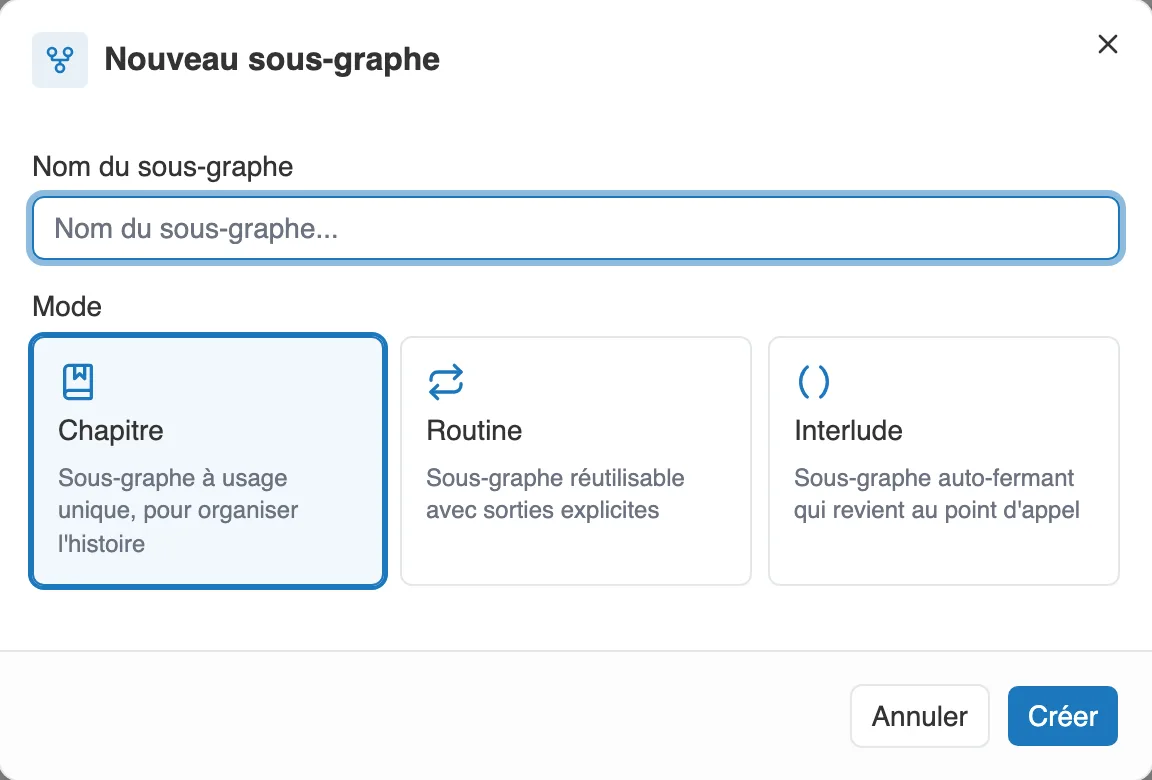
The mode is chosen at creation: Chapter, Routine or Interlude.
The chapter
Section titled “The chapter”A chapter breaks a long story into pieces. It is taken only once, from the main graph, which keeps the structure readable. It is the default mode, the one you pick simply to organize.
The editor holds this rule for you. Once the chapter is placed, it leaves the list of callable sub-graphs, and it does not show up there when you work inside another sub-graph either. Both ways of calling a sub-graph, creating a sequence and linking to an existing sequence, follow the same rule.
Since it is placed only once, a chapter and the sequence that calls it are one and the same. They carry the same name: renaming one renames the other. In the graph, that sequence has a colour of its own, which sets it apart from a routine call.
A chapter has no local variables: what you create inside it belongs to the story. See Local variables.
The interlude
Section titled “The interlude”An interlude is an aside that comes back on its own to its starting point. You open it, it plays out, then reading resumes where it left off. It suits a memory, a closer look at an item, or a thought from the character.
An interlude is therefore not called like the other sub-graphs. Since it retraces its own steps, it has no exit for you to connect. You trigger it in two ways:
- from an option on an item in the inventory. See Items and the inventory.
- from an event. See Events.
The routine
Section titled “The routine”The third mode, Routine, is the classic reusable sub-graph, with exits that you connect yourself. That is the one described in Sub-graphs and routines.